One flat price, 55+ museums and monuments, no queuing for tickets. Here’s everything you need to know before you buy — activation, consecutive days, what’s included, and what isn’t.
The Paris Museum Pass is a flat-rate entry card that gives you unlimited, direct access to 55+ museums, monuments, and châteaux across Paris and the Île-de-France region. You buy it once, activate it on your first visit, and walk straight in — no ticket queues, no per-entry fees.
It’s issued by the Réunion des musées nationaux (RMN), the French public body that manages the national museum network. The pass covers permanent collections at all included venues. It does not cover temporary or special exhibitions, which carry a separate charge even at pass-included museums.
Updated August 2026: Paris Museum Pass prices increased in 2026. current rates: 2-Day €110 · 4-Day €129 · 6-Day €159 — including free 24-hour cancellation. You receive a voucher by email and collect your physical pass in Paris. Children under 18 enter all national museums free. EU residents under 26 also enter free at national museums.
2
Days
€110
Best for weekend breaks or cruise ship stopovers. Hit 4–5 major sites.
4
Days
€129
The sweet spot for first-time Paris visitors. Covers 8–10 museums at a relaxed pace.
6
Days
€159
Ideal for deep-dive trips or return visitors who want the out-of-Paris châteaux.
Step by Step
How to Use the Pass
Using the pass is straightforward, but there are a few things to know — particularly around reservations and activation — to avoid a wasted morning at a museum entrance.
1
Buy your pass before you travel
The easiest option is buying online — you receive a voucher by email within minutes, then exchange it for your physical pass at a collection point in Paris (the Paris City Vision office near the Louvre, tourist offices, FNAC stores, or the CDG/Orly airport desks). You can also buy in person at Paris tourist offices, major museum entrances, and some FNAC stores, but expect queues. Full guide to where to buy →
2
Book timed entry slots in advance
Several major venues — including the Louvre, Versailles, Sainte-Chapelle, and the Orangerie — require a separate timed entry reservation even with a valid pass. Crucially, you do not need your pass in hand to book these slots. Reserve them before you travel. See the full reservations list →
3
Activate on your first use
The pass is not activated at the point of purchase. It activates the first time you use it at a museum entrance. You choose when to start the clock — so if you arrive in Paris on a Sunday evening, don’t activate until Monday morning when you’re ready to visit your first museum.
4
Go straight to the pass holder entrance
At most venues, pass holders use a dedicated fast-track entrance — bypassing the regular ticket queue entirely. At the Louvre, pass holders with a timed-entry reservation should use the Richelieu entrance on the Rue de Rivoli side (not the pyramid) for the shortest wait. Your timed slot confirmation and your pass are all you need at the door.
5
Visit as many museums as you like
Once activated, there’s no limit on how many museums you visit per day. Visit the Louvre in the morning, the Orsay in the afternoon, and the Arc de Triomphe at sunset — all on day one. The pass allows one entry per venue — re-entry to the same museum on a different day requires a new scan, which the pass supports.
Critical Detail
How Consecutive Days Work
This is the most commonly misunderstood aspect of the pass. The days count as consecutive calendar days from the moment of first activation — not museum-opening days, not days you actually visit.
Example: You activate a 2-Day pass at the Louvre on Monday at 10am. Your pass expires at the end of Tuesday — regardless of whether you visited anything on Tuesday. If Monday is a holiday and many museums are closed, those hours still count.
The practical implication: plan your museum days back-to-back. Don’t activate on a Saturday if most of your museum visits are on Monday and Tuesday — you’ll burn a day on Sunday when many museums have reduced hours or are closed.
Also note that many Paris museums close on Monday or Tuesday (not both — they alternate). The Louvre closes on Tuesday. The Orsay closes on Monday. Always check opening days before building your itinerary.
Pro tip: Activate your pass on the day you visit the Louvre — it’s your highest-value site. Build the rest of your itinerary around that day as Day 1. See our 4-Day Itinerary for a fully optimised sequence.
Coverage
What’s Included — and What Isn’t
The pass covers permanent collections at all 55+ included venues. Here’s a clear breakdown of what you get — and the common exclusions that catch visitors off guard.
Included
Permanent collections at all 55+ museums
Versailles Palace & Gardens
Arc de Triomphe roof terrace
Sainte-Chapelle stained glass
All out-of-Paris châteaux
Napoleon’s Tomb at Les Invalides
Notre-Dame Towers & Archaeological Crypt
Not Included
Eiffel Tower (any level)
Paris Catacombs
Opéra Garnier interior tours
Musée Marmottan Monet
Musée Jacquemart-André
Temporary / special exhibitions
Paris metro / transport
Versailles note: The pass covers entry to the Palace, Gardens, the Estate of Trianon (Grand Trianon, Petit Trianon & the Queen’s Hamlet). It does not cover the Musical Fountain Shows or Gardens on show days — these require separate tickets. Budget an extra €12–€18 if you plan to attend a fountain show.
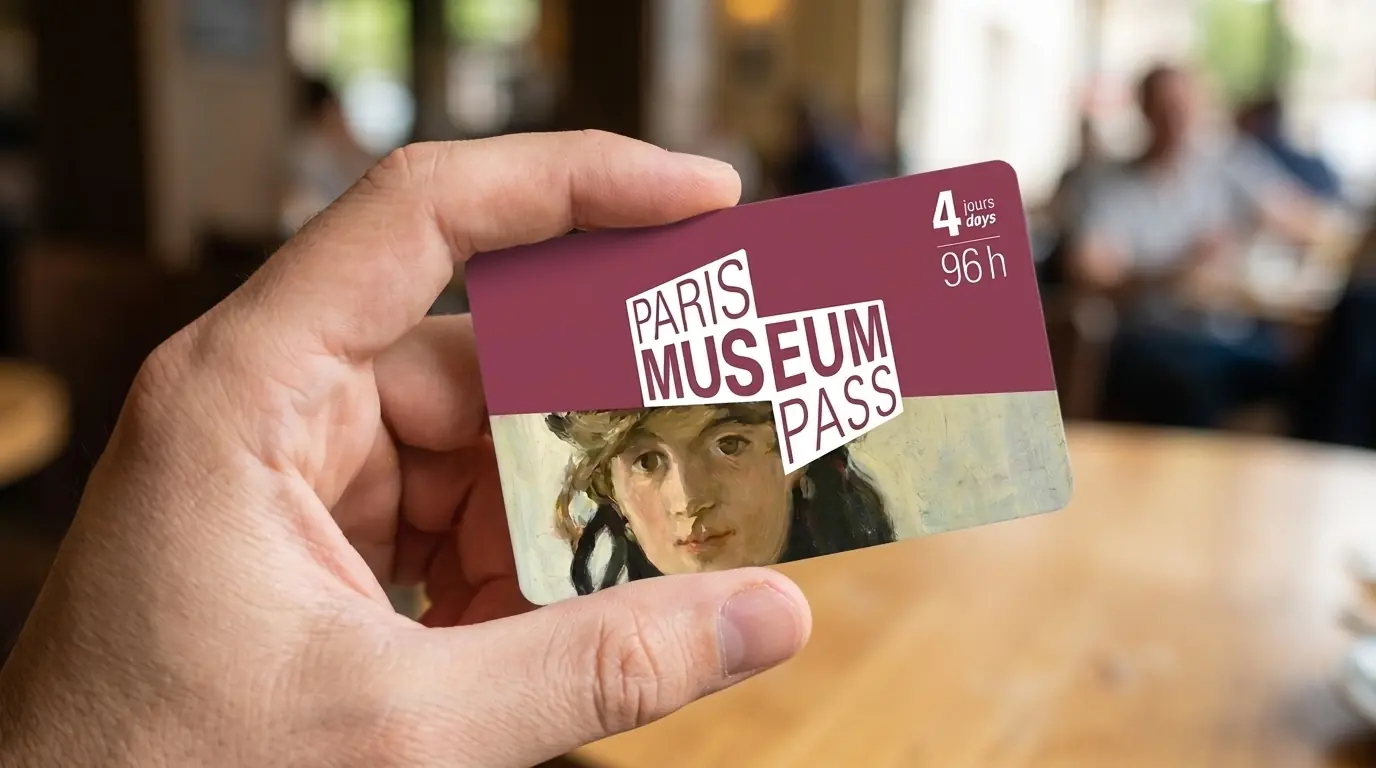
There are two formats. A digital e-ticket exists, but only through the official Paris Museum Pass website — and its online sale has been intermittent. Through most resellers you buy online, receive a voucher by email, and exchange it for a physical card in Paris. That card is what you use at each venue.
Physical card (what you receive through us)
Buy online, get a voucher by email, and collect the credit-card-sized pass at a collection point in Paris — the Paris City Vision office near the Louvre, tourist offices, FNAC stores, or the CDG/Orly airport desks. Present the card at each venue’s pass-holder entrance. Allow a little time to collect it on your first day.
Digital e-ticket (official site only)
The official site sells an e-ticket you keep on your phone, removing the collection step. Availability has been unreliable, and it isn’t the format you receive when booking through resellers.
Yes — you can visit the same museum on multiple days within your pass validity. For example, if you have a 4-day pass and visit the Louvre on Day 1 and want to return on Day 3, the pass allows this. Each entry requires a new scan. You cannot re-enter the same museum on the same day.
No — you do not need your pass in hand to book a time slot. When booking a timed entry at the Louvre (ticketlouvre.fr) or Versailles (chateauversailles.fr), select the “Paris Museum Pass holder” ticket option and book your slot. You’ll show both your time slot confirmation and your pass at the entrance. This means you can reserve slots before you’ve even collected your pass.
There is no discounted version of the Museum Pass for students or seniors — the price is the same for everyone. However, EU residents under 26 get free entry to all French national museums without a pass, so if your group is entirely young EU nationals, the pass may not offer value. Full details: Under 18 & Under 26 Guide →
No. The Paris Museum Pass is strictly non-transferable and tied to a single visitor. Each adult in your group needs their own pass. Museum staff do check, particularly at high-traffic venues like the Louvre. Attempting to share a pass will result in entry being refused.
If you lose your voucher before collecting, retrieve it from your email or reseller account. Once you’ve collected the physical card, keep it safe — a lost card can’t be replaced or refunded.
No — the Paris Museum Pass covers museum entry only. It does not include Paris metro, bus, RER, or any other transport. You’ll need to purchase a separate Navigo Easy card or individual metro tickets. A carnet of 10 t+ tickets costs around €17. For visiting châteaux like Versailles or Fontainebleau, you’ll need RER or train tickets on top of the pass.
Yes — passes are available at Paris tourist offices (including at Gare du Nord, Gare de Lyon, and the Champs-Élysées office), at major museum ticket windows, and at some FNAC stores. However, buying in advance online is strongly recommended as it saves time on arrival and guarantees availability. See: Where to buy in Paris →
Pass at a Glance
Museums covered55+
2-Day price€110
4-Day price€129
6-Day price€159
Under 18Free
EU under 26Free
DeliveryVoucher by email · collect in Paris
Days countedConsecutive
SharableNo — 1 person
Ready to Buy?
Buy online — skip the queue to purchase on the day.